
Blog Category7 Articles

Category: Services

Browse our curated engineering insights, technology trends, and best practice guides on Services.

Explore Topics

Categories

Showing 7 articles in Services

7 Reasons Shopify Is Great for Ecommerce Business
2025-10-17•7 min read

7 Reasons Shopify Is Great for Ecommerce Business

In the competitive world of online retail, choosing the right ecommerce platform can make or break your business. Shopify has emerged as one of the most popular choices for entrepreneurs and established businesses alike. If you're launching your first online store or migrating from another platform, understanding why Shopify stands out is crucial for making an informed decision. This comprehensive guide explores seven compelling reasons why Shopify continues to dominate the ecommerce landscape. User-Friendly Interface and Easy SetupOne of Shopify's most significant advantages is its remarkably intuitive interface that allows anyone to launch an online store without extensive technical knowledge. Unlike complex ecommerce platforms that require coding expertise, Shopify offers a straightforward setup process that can have your store running within hours.Drag-and-Drop Functionality The platform's drag-and-drop builder enables store owners to customize their websites effortlessly. You can add products, create collections, and design your storefront without writing a single line of code. This accessibility makes Shopify particularly attractive for small business owners and entrepreneurs who want to focus on selling rather than wrestling with technical challenges. Quick Onboarding Process Shopify's guided setup walks you through essential steps including domain connection, payment gateway integration, and shipping configuration. This streamlined onboarding ensures that even first-time ecommerce sellers can launch professionally within days. Comprehensive Built-In FeaturesShopify comes packed with essential ecommerce features right out of the box, eliminating the need for multiple third-party integrations from day one. The platform includes inventory management, order processing, customer relationship management, and analytics tools that provide valuable insights into your business performance.The built-in SEO features help optimize your store for search engines, including customizable title tags, meta descriptions and automatic sitemap generation. Additionally, Shopify's mobile-responsive themes ensure your store looks professional on all devices, which is critical as mobile commerce continues to grow exponentiallyExtensive App EcosystemWith over 8,000 apps available in the Shopify App Store, you can extend your store's functionality to meet virtually any business requirement. Whether you need advanced email marketing automation, customer loyalty programs, or sophisticated inventory management, there's likely an app that fits your needs. Marketing and Sales Apps From abandoned cart recovery to social media integration, marketing apps help you attract and retain customers. Popular apps like Klaviyo for email marketing and Yotpo for customer reviews seamlessly integrate with your Shopify store, creating powerful marketing ecosystems.Operations and Fulfillment Apps for dropshipping, print-on-demand, and multi-channel selling expand your business capabilities without significant upfront investment. This flexibility allows businesses to scale and adapt to market demands quickly.Secure and Reliable HostingShopify provides Level 1 PCI DSS compliant hosting, which means your store meets the highest security standards for processing credit card payments. The platform handles all server maintenance, security updates, and ensures 99.98% uptime so you never have to worry about technical infrastructure.This managed hosting approach saves businesses thousands of dollars in server costs and eliminates the need for dedicated IT personnel. Your store remains fast, secure and available 24/7 which provides customers with a reliable shopping experience that builds trust and encourages repeat purchases.Seamless Payment ProcessingShopify Payments has the platform's native payment gateway, accepts all major credit cards and digital wallets without transaction fees. This integrated solution simplifies the checkout process and reduces cart abandonment rates.Multiple Payment OptionsBeyond Shopify Payments, the platform supports over 100 external payment gateways including PayPal, Stripe and regional payment providers. This flexibility ensures you can offer payment methods that your target audience prefers, regardless of their location.Payment MethodTransaction Fee (with Shopify Payments)Transaction Fee (External Gateway)Credit/Debit Cards0%0.5% - 2%PayPal0%2%Digital Wallets0%0.5% - 2%Bank Transfers0%VariesAbandoned Cart RecoveryShopify's built-in abandoned cart recovery feature automatically sends email reminders to customers who leave items in their cart, helping recover potentially lost sales and improving overall conversion rates.Scalability for Growing BusinessesWhether you're processing ten orders per day or ten thousand, Shopify scales effortlessly with your business growth. The platform handles traffic spikes during peak shopping seasons without performance degradation ensuring your customers enjoy smooth shopping experiences even during Black Friday or holiday sales.Multi-Channel SellingShopify enables you to sell across multiple channels including Facebook, Instagram, Amazon, and eBay from a single dashboard. This omnichannel approach maximizes your reach and simplifies inventory management across all selling platforms.Working with a Shopify development company in Ahmedabad can help you leverage these scalability features effectively ensuring your store architecture supports long-term growth and handles increasing complexity as your product catalog and customer base expand.Professional Support and ResourcesShopify offers 24/7 customer support through multiple channels including live chat, email, and phone. The extensive knowledge base, video tutorials, and community forums provide answers to common questions and advanced technical issues.Expert Development ServicesFor businesses requiring custom functionality or advanced integrations, partnering with professional Shopify Development Services ensures your store meets specific business requirements. These experts can create custom themes, develop unique features and optimize your store's performance.If you're based in Gujarat and seeking localized expertise, Infilon which is a Shopify development company in Ahmedabad can provide personalized Shopify Development Services in Ahmedabad with the advantage of understanding regional market dynamics and being available for in-person consultations.Quick Reference: 7 Key Benefits SummaryReasonPrimary BenefitBest ForUser-Friendly InterfaceLaunch stores without codingBeginners, Small BusinessesBuilt-In FeaturesComplete ecommerce solution out-of-boxAll business sizesApp EcosystemUnlimited customization possibilitiesGrowing businessesSecure HostingWorry-free infrastructure managementMerchants focused on salesPayment ProcessingMultiple payment options, low feesInternational sellersScalabilityHandles growth seamlesslyFast-growing brandsProfessional Support24/7 assistance and expert helpEveryoneConclusionShopify just works! Whether you’re selling handmade candles from your kitchen or running a big brand with stores online and in real life. It’s simple to set up, doesn’t require tech skills, and still gives you plenty of room to make your shop look and feel exactly how you want. Shopify provides the tools and flexibility needed for ecommerce success.Because so many developers and creators build tools for Shopify, there’s always something new to help you keep up with what shoppers expect today. You can run your store all on your own or team up with someone who knows the tech side—either way, Shopify helps you create a shopping experience people enjoy, come back to and tell their friends about.
Progressive Web Apps (PWAs) vs Native Apps: Making the Right Choice
2025-10-06•7 min read

Progressive Web Apps (PWAs) vs Native Apps: Making the Right Choice

The mobile app development landscape has evolved significantly, presenting businesses with a crucial decision: should they invest in Progressive Web Apps (PWAs) or native mobile applications? This guide explores the key differences, advantages and considerations to help you make an informed decision for your mobile strategy. Understanding Progressive Web Apps and Native Apps What Are Progressive Web Apps? Progressive Web Apps take a middle ground approach to mobile development by utilizing both mobile and web applications capabilities. PWAs are websites that can perform many functions of a native app like working offline, enabling push notifications, and accessing hardware of a device through browser capabilities. PWAs operate through web browsers and offer an app-like experience by allowing home screen installation and access in full screen. What Are Native Apps? Native applications are software programs developed specifically for particular operating systems such as iOS or Android. Built using platform-specific programming languages like Swift for iOS or Kotlin for Android, native apps are downloaded from app stores and installed directly on users' devices. They have direct access to device features and typically offer superior performance compared to web-based alternatives. Key Differences Between PWAs and Native Apps Development Cost and Time The development process varies significantly between these two approaches. PWAs require a single codebase that works across all platforms, substantially reducing development time and costs. Developers can use familiar web technologies like HTML, CSS and JavaScript that make the talent pool larger and more accessible. Native mobile app development, conversely, requires separate codebases for each platform, effectively doubling the development effort and maintenance requirements. Performance and User Experience Native apps generally deliver superior performance due to their direct integration with device hardware and operating system. They provide smoother animations, faster load times & more responsive interfaces. PWAs have made significant strides in performance optimization but they still operate within browser constraints which can impact speed and responsiveness, particularly for resource-intensive applications. App Store Distribution Distribution channels represent another fundamental difference. Native apps benefit from app store visibility, providing a trusted distribution platform with built-in discovery mechanisms. However, this comes with app store fees, approval processes and compliance requirements. PWAs bypass app stores entirely allowing direct distribution through web URLs though this means missing out on app store marketing opportunities and user trust factors. Advantages of Progressive Web Apps Cross-Platform Compatibility PWAs excel in cross-platform functionality, working seamlessly across different devices, operating systems and browsers. This universal compatibility eliminates the need for platform-specific development, ensuring consistent user experiences regardless of the device. Updates are instantaneous, as users always access the latest version through their browsers. Lower Development Costs The cost-effectiveness of PWA development makes them particularly attractive for startups and businesses with limited budgets. Single codebase maintenance, reduced testing requirements, and elimination of app store fees contribute to significant cost savings throughout the application lifecycle. SEO Benefits Unlike native apps, PWAs are indexable by search engines, providing substantial SEO advantages. This searchability increases organic traffic potential and improves overall digital marketing effectiveness making PWAs excellent choices for content-driven applications. Advantages of Native Apps Superior Performance Native applications leverage device capabilities to their fullest potential, delivering unmatched performance for complex functionalities. Graphics-intensive applications, games, and apps requiring extensive device integration perform significantly better as native implementations. Enhanced Security Native apps offer robust security features through platform-specific encryption and authentication mechanisms. They can implement biometric authentication, secure data storage, and other advanced security measures more effectively than PWAs. Offline Functionality While PWAs offer offline capabilities through service workers, native apps provide more comprehensive offline functionality. They can store larger amounts of data locally and perform complex operations without internet connectivity. Making the Right Choice for Your Business Consider Your Target Audience Understanding your user base is crucial for making the right decision. If your audience primarily uses mobile devices and expects premium performance, native apps might be preferable. For audiences accessing your service across various devices and platforms, PWAs offer better reach and accessibility. Evaluate Your Budget and Resources Budget constraints often dictate the development approach. PWAs require lower initial investment and ongoing maintenance costs, making them ideal for businesses testing new concepts or operating with limited resources. Native apps demand higher investment but may provide better returns for certain use cases. Analyze Your Feature Requirements Complex features requiring deep device integration—such as augmented reality, advanced camera functionality or bluetooth connectivity—typically perform better in native apps. For content-focused applications with standard functionality, PWAs often suffice while providing broader accessibility. Future Trends and Considerations The gap between PWAs and native apps continues to narrow as web technologies advance. Browser capabilities are expanding, allowing PWAs to access more device features previously exclusive to native apps. Major technology companies are investing heavily in PWA development that suggests a bright future for this technology. However, native apps maintain their relevance, particularly for applications requiring maximum performance and device integration. The emergence of cross-platform frameworks like React Native and Flutter offers middle-ground solutions, combining native performance with development efficiency. These frameworks have revolutionized android application development by enabling developers to write code once and deploy it across multiple platforms while still achieving near-native performance and user experience. Conclusion Choosing between Progressive Web Apps and native applications isn't a one-size-fits-all decision. PWAs excel in accessibility, cost-effectiveness and maintenance simplicity, making them ideal for content-driven applications and businesses prioritizing broad reach. Native apps remain superior for performance-critical applications, complex functionalities and premium user experiences. Consider your specific business requirements, target audience expectations, and available resources when making this decision. Many successful businesses adopt a hybrid approach, starting with a PWA to test market viability before investing in native app development. Ultimately, the right choice aligns with your business goals, user needs, and long-term digital strategy.

Low-Code vs No-Code vs Custom Development: A Complete Guide
2025-09-08•7 min read

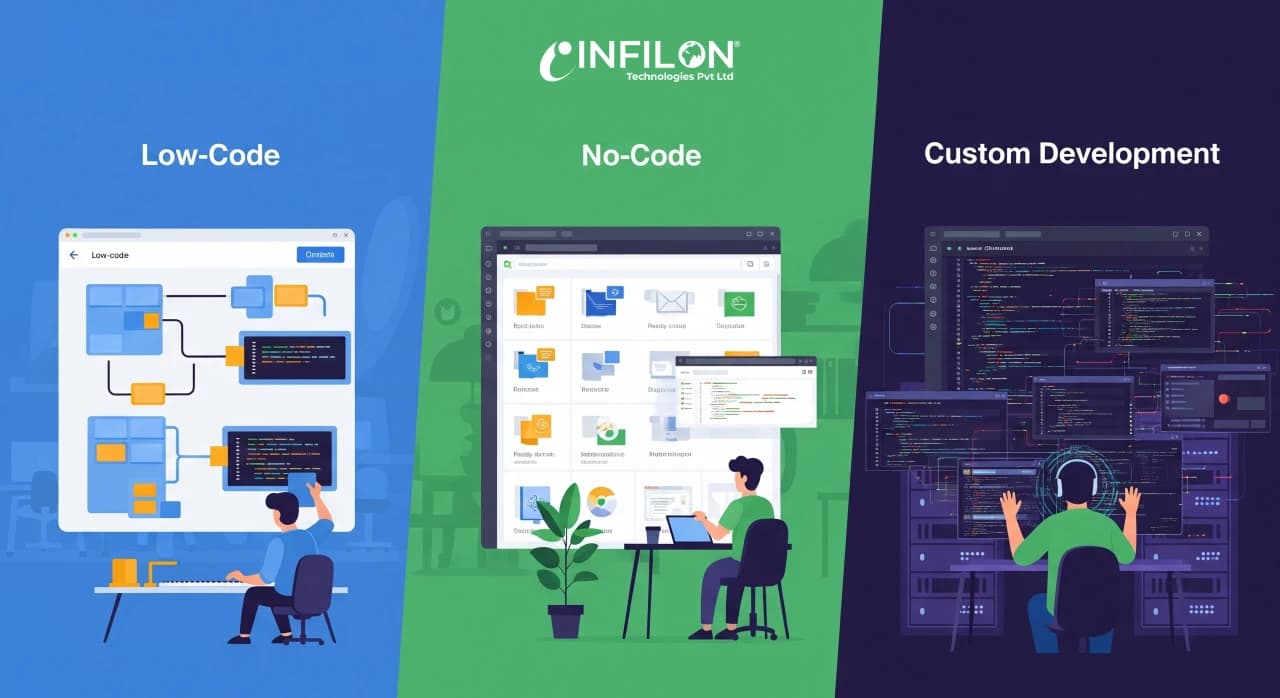
Low-Code vs No-Code vs Custom Development: A Complete Guide

The software development landscape has undergone a dramatic transformation in recent years, with businesses facing a critical choice between three distinct approaches: low-code development, no-code platforms, and traditional custom development. As organizations seek faster time-to-market and cost-effective strategies in 2025's fast-paced digital environment, this decision becomes increasingly crucial, especially with the global low-code market projected to reach $38.84 billion this year and expected to surge to $248.31 billion by 2033.This shift is democratizing app development and reducing reliance on skilled developers amid a persistent talent shortage. This comprehensive guide explores each development approach in detail, examining their strengths, limitations and ideal use cases. While these emerging technologies promise faster deployment and significant cost savings, they're not a one-size-fits-all solution—custom development and professional web development services remain vital for specialized needs. Let's dive into the details to help you choose the right path for your next software project.What is Low-Code Development?Low-code development empowers users to build applications with minimal hand-coding, using visual interfaces, drag-and-drop elements and pre-built templates. It's ideal for developers and IT teams who want to accelerate workflows while retaining some coding flexibility for complex features.Platforms like Mendix, Appian, Microsoft PowerApps, OutSystems, and Zoho Creator lead the best low-code platforms in 2025. These tools integrate AI for automation, support hybrid cloud deployments, and enable rapid prototyping. For instance, low-code reduces development time by up to 90%, making it perfect for enterprises handling large-scale projects.Key benefits include scalability and customization. Low-code trends in 2025 highlight AI-driven development, hyper-automation, and composable architectures. However, it requires basic programming knowledge, distinguishing it from no-code platforms.What is No-Code Development?No-code development takes accessibility further by allowing non-technical users—such as business analysts or marketers—to create apps without writing any code. It relies entirely on intuitive visual builders, automation workflows, and ready-made components.Top no-code tools in 2025 include Bubble for web apps, Adalo for mobile, Zapier for integrations, Appy Pie for multi-purpose apps, and Softr for data management. These platforms deliver 362% ROI and 90% faster launches. No-code vs custom development shines in simplicity, enabling quick MVPs for startups.Growth statistics show no-code platforms powering 72% of startup apps in 2024, with even higher adoption expected in 2025. Trends focus on AI integration and marketplaces but limitations arise in handling highly complex or customized requirements.What is Custom Development?Custom software development involves building applications from scratch using traditional coding languages like Python, Java or JavaScript. It offers complete control, tailored to specific business needs without platform constraints.In 2025, custom development trends include AI-powered automation, quantum computing, and enhanced cybersecurity. It's favored for industries like finance or healthcare requiring bespoke features. Unlike low-code vs no-code, custom coding ensures optimal performance and integration.However, it demands skilled developers, longer timelines (months to years), and higher costs—often 5-10 times more than no-code solutions. Hybrid approaches blending custom with low-code are rising, as seen in software development trends 2025.Differences Between Low-Code, No-Code & Custom DevelopmentTo clarify low-code vs no-code vs custom development, here's a comparison table:This AI model comparison highlights how low-code bridges no-code's ease and custom's depth.Pros and Cons of Each ApproachLow-Code Pros and Cons: Pros include faster deployment, cost efficiency (up to 70% savings), and flexibility. Cons: Vendor lock-in and learning curve for non-coders.No-Code Pros and Cons: Pros feature accessibility, rapid iteration, and low barriers. Cons: Limited complexity handling and potential security gaps in templates.Custom Development Pros and Cons: Pros offer tailored functionality, superior security, and long-term scalability. Cons: High costs, extended timelines and developer dependency.In low-code vs no-code, the former suits complex projects, while no-code excels in simplicity. Vs custom, both reduce expenses but may compromise on uniqueness.When to Choose Low-Code, No-Code or Custom DevelopmentChoose low-code for mid-sized enterprises needing quick, customizable apps—like internal tools or CRM integrations. Opt for no-code platforms if you're a small business or solo entrepreneur building MVPs, such as e-commerce sites or workflows.Reserve custom software development for high-stakes scenarios: regulated industries, data-intensive apps, or when off-the-shelf won't suffice. In 2025, hybrids are popular—using low-code for core features and custom for edges. Assess your team's skills, budget, and timeline to decide.Future TrendsThe software development landscape is experiencing unprecedented convergence, with boundaries between no-code, low-code and custom development rapidly dissolving. Modern platforms support multiple development paradigms within unified environments, driving remarkable market growth—with low-code platforms achieving a 20.61% CAGR and projections indicating 75% of new applications will utilize low-code technologies by 2026. Artificial intelligence is revolutionizing every approach through AI-assisted code generation, intelligent automation, and personalization features, fundamentally transforming how developers work and how every custom software development company operates, while enabling non-technical users to create sophisticated applications with automated testing and advanced analytics capabilities.The architectural evolution toward microservices and API-first design enables seamless integration of different development methodologies, allowing organizations to combine custom-coded components for complex logic with low-code modules for rapid deployment and no-code interfaces for user-facing elements.Emerging technologies like edge computing, enhanced cybersecurity protocols, and cloud-native applications are accelerating this hybrid model, creating an ecosystem where hyper-personalization and enterprise scalability coexist naturally. This convergence empowers organizations to leverage the most appropriate development approach for each component while maintaining seamless integration across their entire application ecosystem.ConclusionNavigating low-code vs no-code vs custom development in 2025 boils down to your needs: speed and ease with no-code, balance with low-code or precision with custom. The right choice can transform your business with booming markets and innovative tools. Explore best low-code platforms like Mendix or no-code tools like Bubble today. For tailored advice, consult experts to stay ahead in this evolving field.

LLM vs Generative AI: What's Actually Different?
2025-09-02•7 min read

LLM vs Generative AI: What's Actually Different?

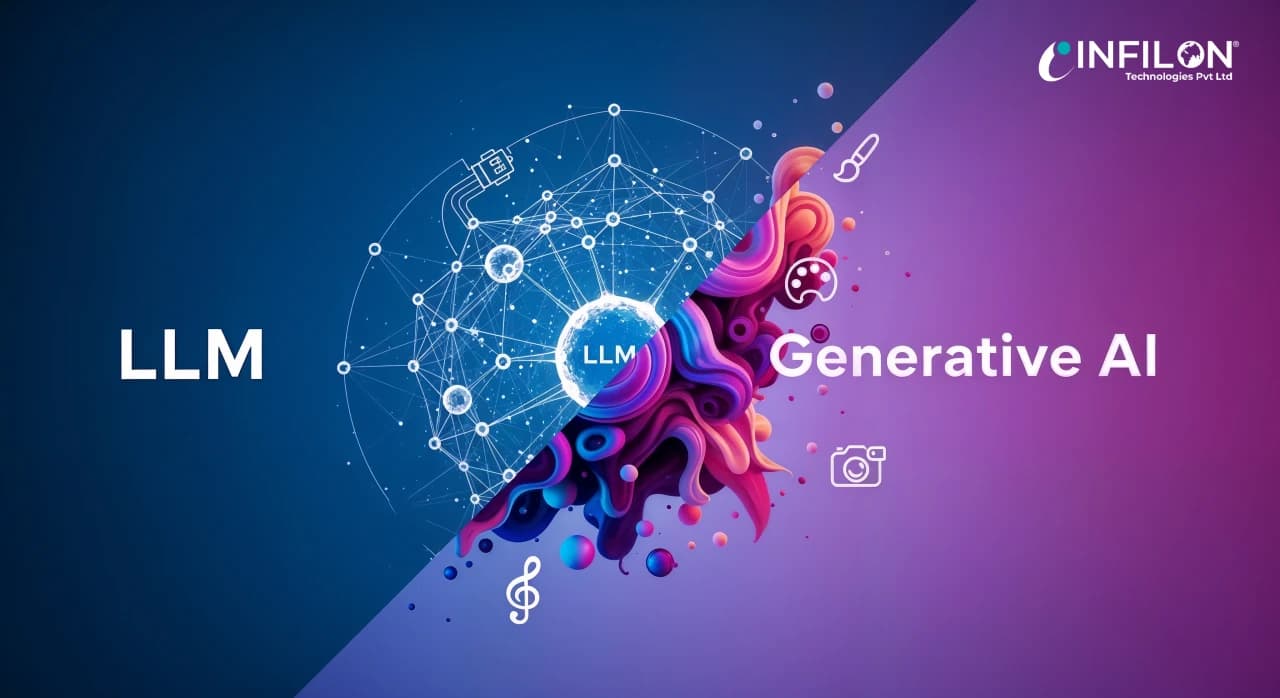
If you've been anywhere near the tech world lately, you've probably heard people tossing around terms like 'LLM' and 'Generative AI' as if they're the same thing. This confusion isn't just a minor annoyance – it's actually holding back tech enthusiasts, businesses, and developers from making the most of these powerful technologies. Think of Generative AI as a vast creative studio that can produce new content across every medium imaginable, while LLMs are the master wordsmiths within that ecosystem, specializing in understanding and generating text with remarkable sophistication.As organizations increasingly explore custom LLMs tailored to their specific industry needs and data requirements. Throughout this blog, we'll explore the key distinctions between these technologies, examine their real-world applications, and look ahead to future trends. By the end, you'll have a clear understanding of generative artificial intelligence in all its forms, and more importantly, you'll know exactly which approach makes sense for your specific goals.What is Generative AI?Generative AI represents a category of AI systems with a unique superpower: creating completely new content. These systems learn patterns from existing data to generate something that never existed before. This sets generative AI apart from traditional AI which focuses on analyzing or classifying data. Instead of processing what exists, Generative AI acts as a creative partner, producing fresh outputs: text, images, videos, code and audio. Behind the scenes it leverages advanced neural networks like GANs and diffusion models that teach machines to mimic human creativity. The result is AI that doesn't just understand patterns but uses them to create something new.Generative AI trains on massive datasets to predict and produce new creations. Tools like Flux and Midjourney generate images from text descriptions while MusicGen creates original music. The technology has exploded in popularity across entertainment and marketing and design. Investments reached $33.9 billion globally in 2024.The technology's strength lies in its multimodality that handles diverse inputs and outputs. You can input a sketch and get a polished video or combine text with audio for personalized podcasts. However challenges persist including data biases and ethical concerns. These models can replicate harmful stereotypes from their training data. Generative AI democratizes creativity by enabling non-experts to produce high-quality content efficiently.What is a Large Language Model (LLM)?A Large Language Model (LLM) is a type of artificial intelligence model that has been developed to process, interpret, and generate human-like text. LLMs rely on deep learning architectures, particularly transformers, and are pre-trained on a massive corpora of text data—literally billions of words of text from books, websites, and articles—to predict the next word in a sequence. This creates an inherent fluency in tasks such as summarization, translation, and conversation.Some familiar examples of LLMs include OpenAI's GPT-5, Anthropic's Claude, Meta's Llama series, Google's Gemini, and xAI's Grok 4. These models excel in natural language processing (NLP), making them ideal for chatbots, content writing and code generation. GPT-5 allows you to write emails or respond to prompts, to more utility by pulling a function out of a prompt in python code! LLMs represent a pinnacle of language-focused AI, with parameters often exceeding hundreds of billions, allowing for nuanced context understanding. However, LLMs are focused mainly on text which limits their functionality compared to broader AI systems. In 2025, open-sources like Llama 4, first began to hit the mainstream, thus expanding accessibility and customization. Despite their power, LLMs face issues like hallucinations—generating plausible but incorrect information and high computational demands.Key Differences Between LLM & Generative AIWhile LLMs are a form of Generative AI, the differences between LLM and Generative AI are significant in scope, functionality, and application. Generative AI is an umbrella term for any AI that creates new content across modalities, whereas LLMs are specifically tailored for language tasks.Here's a detailed AI models comparison:In terms of use cases, Generative AI shines in creative industries like generating artwork or videos while LLMs dominate in text-heavy domains such as legal drafting or customer support. The key takeaway? All LLMs are Generative AI but not all Generative AI is an LLM.Similarities Between LLM & Generative AIDespite the differences, LLM and Generative AI share foundational principles. Both rely on machine learning to generate novel outputs from learned patterns, using large datasets for training. They employ probabilistic methods to create content that's contextually relevant and human-like. Ethical challenges such as data privacy and bias mitigation, apply to both, as do advancements in efficiency through techniques like fine-tuning. In hybrid applications, LLMs often integrate with Generative AI for enhanced multimodal experiences like voice-assisted chatbots.Real-World Applications and Use CasesGenerative AI's applications are vast: in healthcare, it aids in drug discovery by simulating molecular structures; in entertainment, tools like Stable Diffusion create custom visuals. On the other hand, LLMs power virtual assistants (e.g., ChatGPT for queries), automate coding (GitHub Copilot) and enhance education through personalized tutoring.For businesses, choosing between them depends on needs—use Generative AI for multimedia campaigns and LLMs for content marketing or SEO optimization.The combination of LLMs and generative AI is transforming industries across the board: E-commerce: Personalized product recommendations Dynamic product descriptions AI-generated product images Customer service chatbots Content Creation: Blog post generation and optimization Social media content creation Video script writing Image and graphics generation Healthcare: Medical documentation and summarization Patient communication tools Medical imaging analysis Drug discovery research Education: Personalized learning materials Language translation tools Interactive tutoring systems Content summarization for research Future Trends in LLM & Generative AILooking ahead, 2025 promises exciting developments. Multimodal integration will blur lines, with LLMs evolving into agentic AI systems that act autonomously. Open-source models will democratize access, while ethical AI and sustainability focus on reducing energy consumption. Investments in Generative AI are projected to boost global GDP by 7%, with trends like hyper-personalization and dynamic model selection leading the way.ConclusionIn the LLM vs Generative AI debate, the real value lies in their complementary strengths. Generative AI offers boundless creativity across formats while LLMs provide precise language mastery. By understanding the differences between the two, you can use the most appropriate tool for innovation. As AI develops, understanding generative artificial intelligence and large language models will be vital. Ready to implement? Explore these technologies today and transform your workflow.

Some ways mobile apps can help you grow your business
2022-01-19•5 min read

Some ways mobile apps can help you grow your business

Digital technology and mobile apps are dominating the world and dominating people's lives in various ways. Businesses across industries are taking advantage of the vast capabilities of the AI-ML mobile app and other technologies to consistently generate profitable returns. Start-ups, SMBs, and enterprises are gaining a competitive edge in the market, thanks to the digital in mobile app technology and ecosystem, B2B, B2C businesses are thriving in their industries, and consumers are becoming increasingly aware of their mobile devices. There is convenience and comfort in using the mobile app. Buying, selling, doing business, negotiating is now easier and businesses can now easily connect with their target audience. Thus, businesses can approach a mobile app development company for a mobile application development idea and benefit from the process. Maximum Benefit Mobile Apps The best idea is to contact your mobile app development company to limit your specific app development and which platform you should choose. First, you need to know your market, target audience, their specific needs, demographic details, and then see if Android, iOS, or cross-platform app development is right for your business. The mobile app has many advantages for all businesses, be it B2B or B2C, online forums get additional benefits due to the potential choice of transactions between businesses and customers respectively. In fact, websites and desktops have become obsolete technology because people do not want to spend too much time on them and want to use mobile phones in every way. Any business, any sector, retail, healthcare, travel, tourism and hospitality, logistics, you think of an industry and you have a unique mobile application for your business and segment. Mobile applications have become the best user interface and UI / UX design can enhance your customer experience. Mobile app development can increase your traffic You can drive traffic to your app, app pages, websites, and more through your application, e.g., customers/clients can pay online through various payment gateways, digital wallets and this allows them to make convenient purchases and purchases. Purchase privileges are available. Simply clicking, browsing through a wide range, and multiple options attract your target customers, users, and those who bring them to your application, download and install them on your mobile phone. This leads to increased traffic to your websites and accelerates business returns. Just take an example when your target users download your app on your mobile phone, your brand will be in constant view of your mobile app users, and whenever they open the app, scroll through it, browse, your brand will be at the forefront. This is how you manage to be present in the lives of your client through your exclusive mobile apps. Increase your brand presence, brand value. This will have a positive effect on the return of your business. How can mobile apps help your business grow? 1. Working as your branding tool Mobile apps come in the form of iOS apps, Android apps, Cross-Platform apps that help you to grow your brand strategies and are the best ways you can glorify your branding strategy that can boost your brand promotion and enhance your customer/ user experience. Your mobile app development company can take advantage of the digital capabilities of your mobile app and build your app in a way that integrates important features in a way that suits your reach. The scope of digital marketing increases the visibility of your brand in the market. Ads, campaigns, images, videos, icons, gifs, animations are other tools that can serve as your branding tool for achieving your business goals. An Android mobile app, iOS mobile app, or any mobile app for your business, your logo reflects the presence of your brand and establishes your unique identity. Your special theme/logo stays in the minds of consumers, application users, and from there your brand identity, visibility is constantly increasing. In short, you're always in constant touch with your customers through your mobile app. 2. Customer relationships are enhanced If you know your target audience and their specific interests, you can provide them with what they want through your unique mobile app. You can personalize your offers with a variety of promotions, value-based offers that engage with your target app users and create a place in their hearts. By looking at your personal products and offers, consumers will accept your products and build a special relationship with your brand. In short, your mobile app can build a special relationship with your customers and clients. Better customer experience is the ultimate goal. Thus, a mobile app is a time-saving, cost-saving thing that allows your app viewers to know about your new offers, products, and market launches. 3. Production of income Mobile apps, Android apps, iOS apps are all excellent sources of income-generating, revenue-generating. Only your app has functions that can allow the integration of buttons, ads and whenever your potential customer opens your mobile app on their device, your featured ad will appear in front of them, on their screen/monitor. Thus, your mobile application is also an income generation platform. In addition, there is a paid version of your app and users connect to your app by paying a subscription fee. And it serves as a huge addition to your business's revenue generation. For the e-commerce sector, various mobile apps have greatly increased the potential for revenue growth. In addition, you can enhance the features of your mobile app, including integrated offers in your loyalty program, apps. This feature allows you to earn various benefits, cashback, points, win credits by selling/buying online. 4. Increase online attendance Your business's mobile apps are also your marketing tools to interact directly with your target users/target customers. An application is a direct communication channel between your brand and your customers. Your app can be included in the list of good reviews and ratings in Google Playstore, Appstore. This will lead to an increase in downloads across various app stores as your target audience now knows your brand and is willing to install your app on their mobile phone. Thus, having a mobile app for your business, your brand is a win-win situation as it increases the visibility of your brand in the market. 5. Efficiency is high Whether you are a retailer or an online retailer in the online segment, mobile apps are user-friendly and allow customers to make seamless and manageable purchases of your products at the click of a mobile button. The friendly user interface, product classification, online payment system are all integrated features available in the apps. This leads to easier integration between businesses and customers and consequently increases operational efficiency. Conclusion Mobile applications have accelerated the way businesses run just by achieving maximum results. It has changed the way businesses operate in all industries globally. Your business can engage with your target audience regardless of geographical boundaries and time zones. Then you just need to contact a complete mobile application and web development company that can guide you to build your application from scratch. If you are a start-up or entrepreneur and would like to know how mobile application development can enhance your business prospects, contact us.

Is your website being ignored?
2021-07-12•5 min read

Is your website being ignored?

Is your website being ignored? These are 5 reasons why your website is not being seen. Your website should be ranked high in all search engines. You want to attract as much organic traffic as possible. The lack of effective SEO services in India means that many business owners miss out on organic traffic. Infilon is an SEO Company in Ahmedabad that has helped many clients increase organic traffic to their websites. We are also known for being one of the top SEO agencies in India. How to help you analyze the possible reasons why people are ignoring your website. Loading time It is important to pay attention to website loading times. Websites that load quickly receive more traffic than those with slower loading times. A website’s loading time is the time it takes to load fully. The faster a site loads, the better the user experience. To get more visitors, website speed is crucial. The SEO rating of a website is also affected by its loading time. The SEO rating will drop if a website takes longer to load. This factor can cause your website rank to drop slowly, which will affect your website’s traffic. Your SEO company is crucial in helping you navigate this issue. Many Indian SEO companies fail to properly guide their customers. Responsive web design A responsive website is one that adapts to any screen size. Websites that do not use responsive design will show users the desktop version for all devices. Most users today prefer to use their mobile phones and tablets to surf the web. Users will have to zoom in and out several times to see the desktop version on their cell phones. Users lose interest in your site. Too many popups While pop-ups can be helpful in increasing conversion rates, they are not good for websites. Excessive pop-ups can cause irritation and hamper the user experience. It is important to make it easy for users to delete pop-ups from your website. Your existing users should not be confronted with pop-ups. Too many ads Advertisements can be a great way to generate revenue and bread & butter income. Too many advertisements are a bad idea. It deters visitors from enjoying a positive experience on your site. Users can also be annoyed by too many ads. It gives users the impression that your primary concern is revenue, rather than quality content. This can impact the rank of your website. Security While secure websites include HTTPS in the address, un-secure websites use HTTP. This is the easiest way to identify safe websites. It is not safe to make a payment on websites that use the HTTP protocol. These websites could steal confidential information. It is essential to have a secure and safe website, especially when money transactions are involved. This will build trust and make your users feel at ease while they browse your website. When developing your website, ensure you take into consideration the following factors and only work with the best SEO company Ahmedabad. Infilon SEO Company is available to answer any questions regarding website development. For inquiries and consultations, call us at 8000230350.

Double your leads, traffic, and conversions today! Here’s how!
2021-06-28•4 min read

Double your leads, traffic, and conversions today! Here’s how!

Like any website, you want to rank high on Google results and get the best ROI from your PPC campaigns. Your website may have a specific focus area, but then the topic can be so wide that it becomes very challenging to size the websites and content on an extended theme. It is well known that Google needs to provide the most relevant results to its searchers. However ‘relative’ can often be a very subjective word. So, if you want to know what works best for your website, you have to test it. And not just any scientifically supported, logical, and analytical tests that guarantee the best return for your strategy. SEO companies like Infilon Technologies help you understand this and stay ahead of your competitors. What is a Scientific SEO? The scientific strategy of SEO optimization is prudent and efficient in driving more traffic, which proves to be suitable for the growth of your business. Constant monitoring can keep track of your SEO experiments by recording your observations and queries. Using your own website data is a smart idea to point you to the probability of a positive impact. However, research is key. Research is essential for the fruitful results of your SEO strategy. Look for any existing content about your focus area in blog posts by Google Webmasters, Google Patents, third-party analytics, etc. A well-thought-out research study will help you limit your concept to the most practical and realistic. How can you apply for your business? Once you have a basic understanding, this is the time to be creative and not be afraid to experiment. Running experiments and getting accurate results can be challenging. But experiments will not only help you create more compelling results but also ensure that you don’t go through the motions of changing your website badly or unreasonably. You will only invest in changes that you think will work in your favor. Finally, analyze and report. Analyzing your data can help you reach a logical conclusion. Based on the data, you’re trying to find out if your suggestions and updates are relevant. There is a list of many “SEO best practices” and “ranking factors”. However, in the long run, each of them proves futile. Although they may provide temporary relief, the effect wears off over time. But when it comes to the SEO strategy done by an SEO company in Ahmedabad, there is no room for fading or mistakes. We set the trend! In the end, the primary way to keep up with the ever-changing world of internet marketing is to test, test, and re-test. And, it’s a surefire way to draw educated conclusions on what works and what doesn’t, using a scientific approach to your website’s SEO.

Transform Your Vision

Explore how our services can be integrated with your business.

Partner with Infilon's expert engineering team to develop custom AI models, high-performance web applications, mobile platforms, and enterprise solutions.